
If Creating Could Only Be So Simple
A guest post from Sarah Kilgallon


Hi friends,
Our new guest post comes to you from artist and previous WRJ contributor Sarah Kilgallon. You can find her in Issue 27, Issue 23 (cover art), and others.
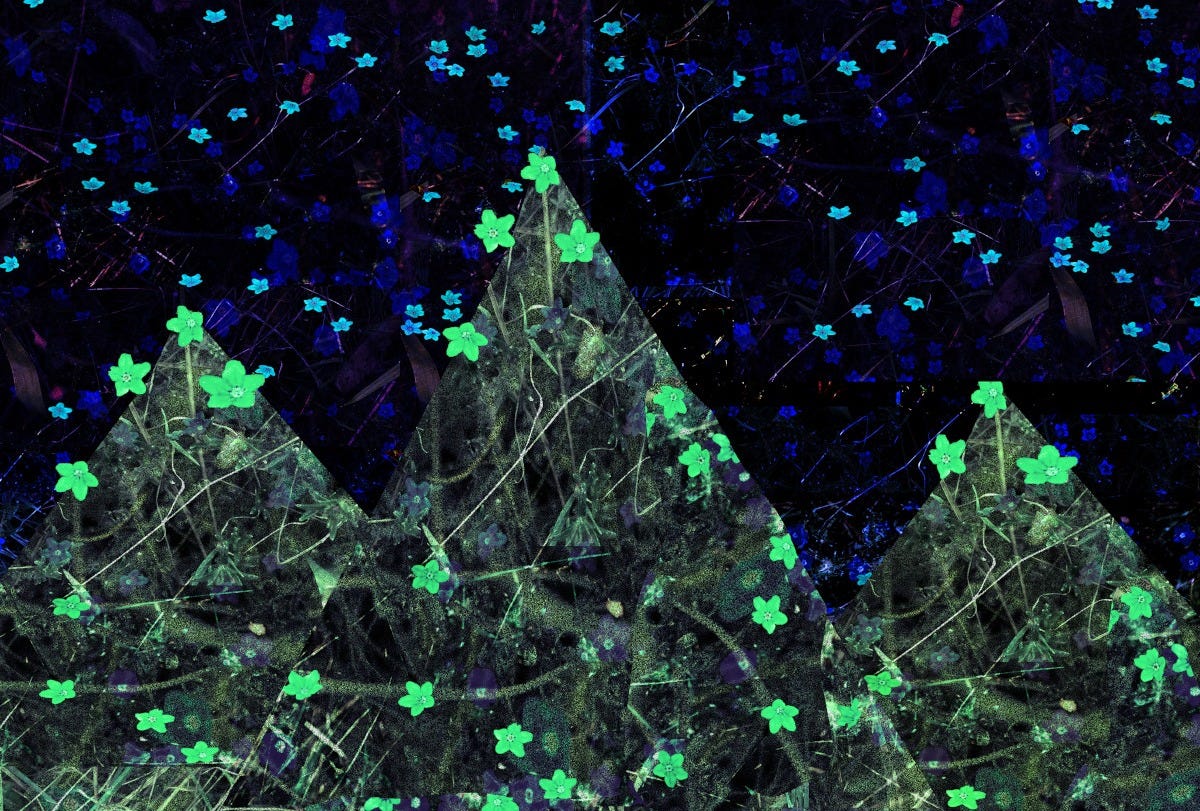
“Mountains at Night,” from Issue 23
If Creating Could Only Be So Simple
Sarah Kilgallon
Plato’s philosophy of forms, and his belief of the existence of ideal versions, relies on the perfection of the mind’s image. While the outcomes of this image are imperfect replications, with poetry and painting relegated to being twice removed from the mind’s truth.
This concept has always bothered me—perfection and imperfection, truth and falsehood. Shifts of perspectives and evolution seem more suited when speaking about my art and my life.
When an image takes shape in my imagination, this impression wants to latch onto a past idea. The image clings to find a meaning, a recognizable design. Inevitably, words tumble down and cage my once free-flowing impression, tangled with what I’ve read, seen, talked about, heard of. With nowhere to grow, the image turns stale.
The only thing for me to do is take a walk and clear my mind of this sudden metropolis of noise caused by the ideation of this one image.
In my life, I’ve walked a lot: mountains, woodlands, trails, high desert, and ocean beaches. It’s about being out of doors, away from the noise of everyday civilization, that allows me to think beyond this seed of an image. If I didn’t have this physical and mental relief, I don’t believe any of my artistic work would ever come to fruition.
The reference for all my work begins with nature because the light, earth, water, rain, and snow reflect back to me that being a speck in the natural world is okay, expected, and not something to overcome. I welcome being a speck against the shore break, but dread being flicked away like a speck of dirt by the overwhelming events of our society. I take both these states as a truth of my human existence, however, and use them to further inform my artistic process.
I find myself drawn to the details of everyday nature. In the forest, I’m drawn to the pockets of sunlight breaching the foliage. At the beach, I’m looking to capture the shadows escaping the overexposed seascape. And this is the crux of my creativity, when the seed of an image suffocated by ideas, words, and expectations has the chance to breathe. There’s nothing in nature that is perfectly smooth, straight, or level, yet the mountain holds up, the tree stands, water flows where it finds a passageway.
By pressing the shutter on my camera, I’ve captured the essence of the image crowding my thoughts. I have no desire to exactly replicate the picture in my mind. How boring.
My reality and truth begin when the image shifts, bringing along the mess of uncertainty that comes it.
The photo I created doesn’t stand alone. I’ve taken several photos, probably a series. And the photographs are never the end of the story I’m trying to tell. They’ve only fired up my imagination.
For the last six years, I’ve been blending photography and painting. There’s some sort of story I want to tell about myself, about nature, our society, our humanity. My inspiration and motivation for this work are partly a mystery to me, and I don’t care to solve it. I’d rather have the understanding rise up on its own.
But it’s a messy business, never straightforward, and many hours are spent trying to uncover what my blended-medium wants to be. And it’s never only the visual. Alongside my artwork is a running essay or poem that I scratch out in my notebooks. The conversation among the mixed media is ongoing and abstract. The art and the words may never meet, but they form my artistic expression.
My artwork is my good work, the important work. When I create, I build a bridge from my humanity to yours. And nothing is more important to me.
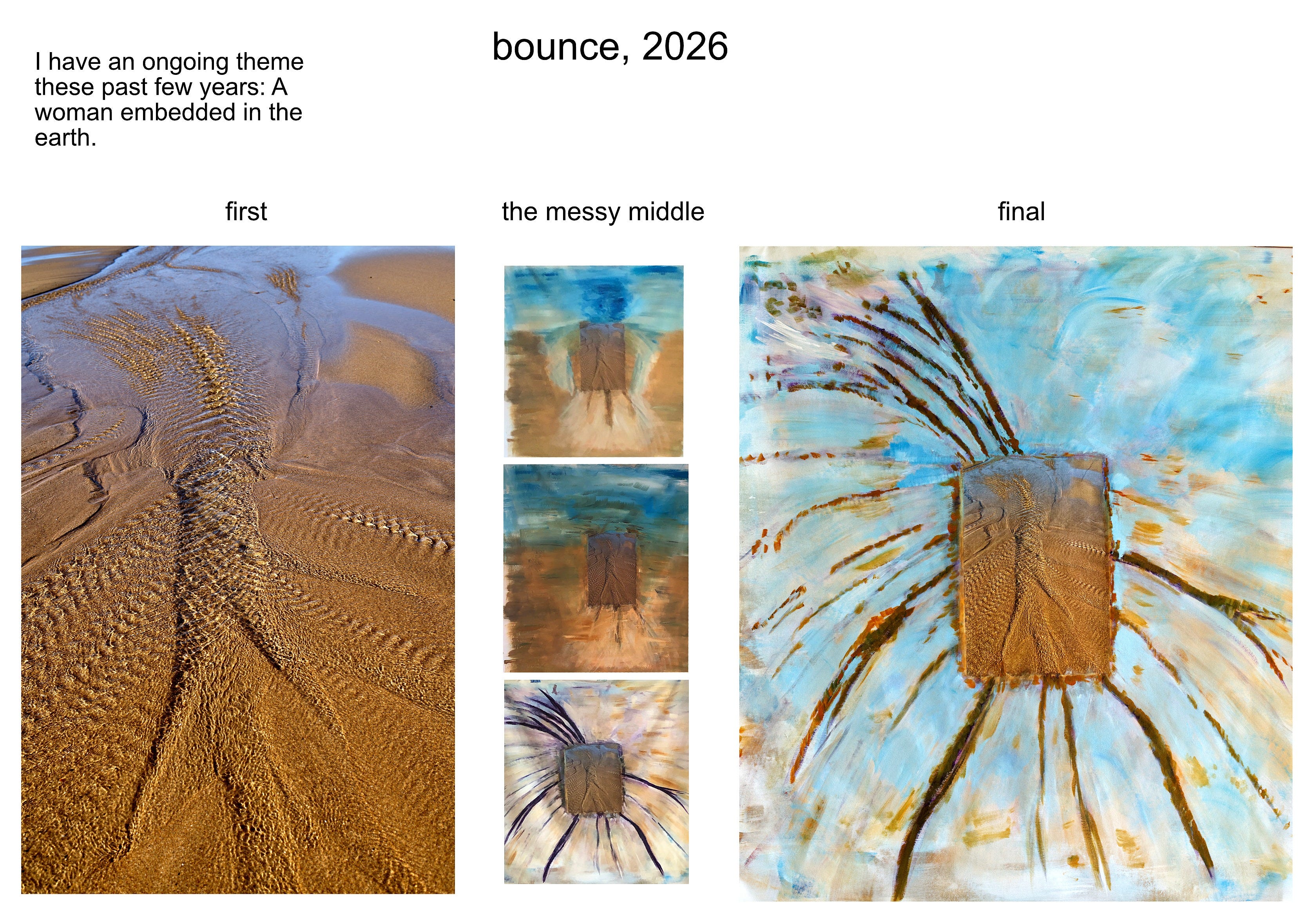
Here are two examples:
The image and its evolution from a photo to blended-medium work: “bounce”
And a poem: “Vast”
I created this short verse for a chapbook I recently finished. In my other daily work of language learning, I asked a friend of mine to translate the poem into Portuguese. I find that having the two versions side by side creates another conversation between my language and a collaborator.
THE VAST

Rending gashes, pulsing canyons
my echo forgets to find me.
I’m too deep.
What I can’t swallow wastes away under a coarse sun,
a trace of nostalgia to taste on my tongue.
Life is beyond humanity.
I do not wish to be anything than my humanness. The darkness and weight of my pieces.
My purposeful forgetting.
My body can’t. My thoughts won’t. Caught
between instinct and non-being.
This is why I love the water against my skin. I am buoyant.
The elasticity of the water like
Love?
If only.

******

O VASTO

Rasgando brechas, pulsando por desfiladeiros
O meu eco esquece-se de me encontrar.
Onde estou é demasiado fundo.
O que não consigo engolir gasta-se debaixo do sol grosseiro,
um vestígio nostálgico, este gosto na minha língua.
A vida está além da humanidade.
Não desejo encarnar nada da minha humanidade. A escuridão, o peso dos pedaços do meu ser.
Um esquecer propositado.
O meu corpo não pode. Os meus pensamentos não irão. Apanhada
entre o instinto e o não-ser.
É por isto que amo água sobre a minha pele. Flutuo.
A elasticidade da água como
Amor?
Se assim fosse.

Sarah Kilgallon is originally from Boston now living in Lisbon, Portugal. She’s a journalist for the sexual health sector focusing on women’s health and mental well-being. Recent exhibits include: "Intangible Edges" (Alges, Lisboa district, Portugal); a wall-sized photo collage on permanent display at Boston Children’s Hospital, Boston, MA; and Welcome to the Wilderness (photography and essay series), which completed a two-month showing in 2024 at Centro de Interpretação de Monsanto, Lisboa. Her essay “My Idyllic Defense of Walking” was published in Sage Magazine in 2024. Website: sarahkilgallon.com
Subscribe to see more guest posts from WRJ’s amazing contributors / Paid access includes editorial feedback for 1 poem each month, Q&A with the editor, and more.
 | A guest post by
|
Beautiful and eloquent description of an artist's process. I always love seeing behind the scenes. "My reality and truth begin when the image shifts, bringing along the mess of uncertainty that comes it." And as writers, uncertainty is the land we much live in much of the time, and must be comfortable existing inside. Lovely essay!