
Notebook Navigation: Precision can be a kind of poetry
Let's hit the (note)books and do some writing. Notebook Navigation is a series of creativity prompts and exercises to spark the writing process

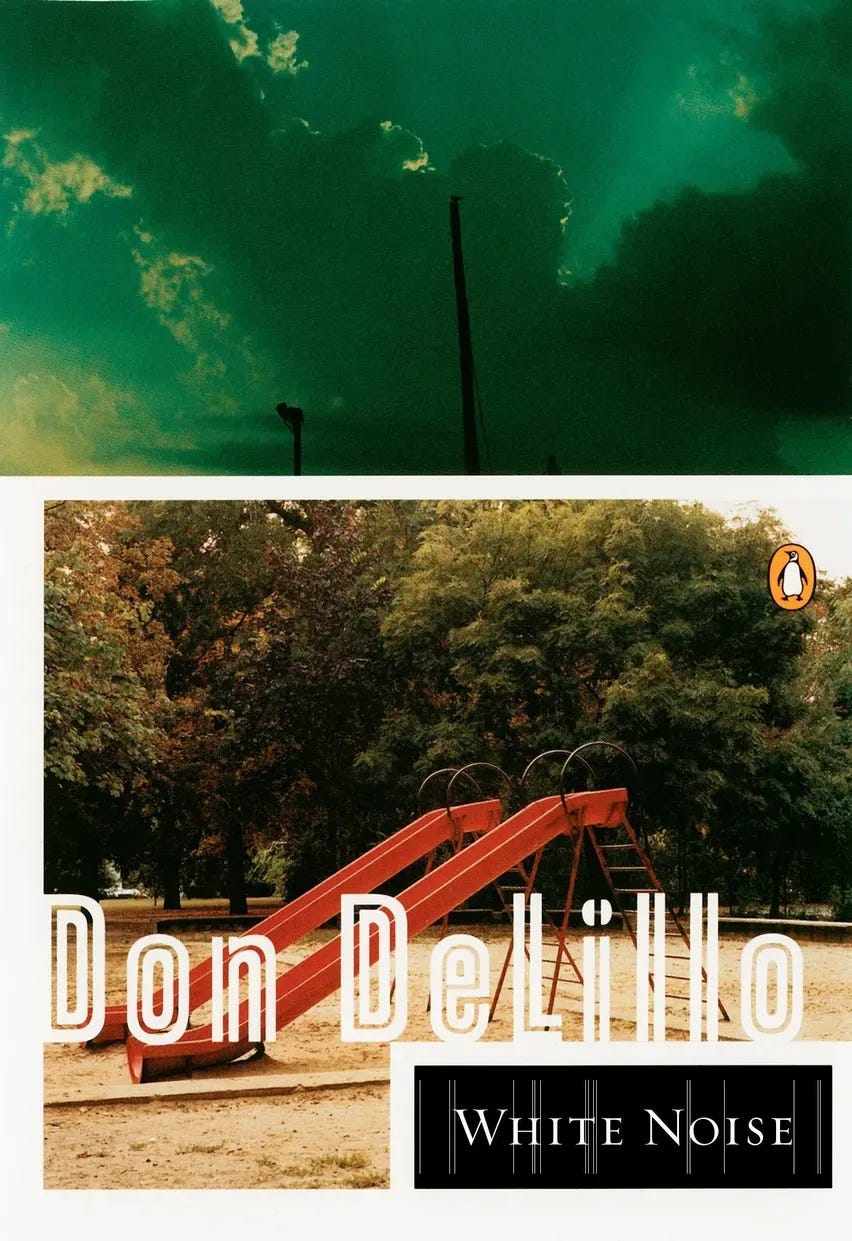
In this installment of Notebook Navigation, we will consider Don DeLillo’s 1985 classic, White Noise.
The Notebook Navigation series is intended to be reminder to write something in your notebook today, a quick refresh for your creative writing process. Today, we will dive into the opening paragraphs of White Noise, emphasizing the precise use of language—a deep attentiveness that we can, perhaps, carry into our own writing.
White Noise and I go way back. I first read it in 2004, and subsequently, it became the focus for a chapter of my MA thesis. Like many DeLillo readers, it was the first of his novels that I encountered. At first, I was captivated by the display of late 20th century consumer culture—the brightly lit supermarket, eye-catching packages, constant background chatter of TV advertising, and overabundance of information that spans the full spectrum of credibility levels.
Even though there’s no internet in the world of the book, no iphones, no social media (and no Substack . . . how did we survive!), reading the novel today feels more relevant than ever, both in DeLillo’s treatment of consumer capitalism and of the dominance of technology within every facet of life. And running through these layers of cultural critique is DeLillo’s careful attention to the question of what makes us a people, a nation—the subtle connections we develop within structures of family, community, and workplace.
Below, I’ve included the first two paragraphs of White Noise, as well as a brief commentary that I found to be an interesting illustration on the importance of a single sentence, even within a work consisting of thousands of sentences.
If you’re new to the book and are looking for some context, this episode of the Don DeLillo Should Win the Nobel Prize podcast wonderfully sets the scene.
Subscribe and support what we do as an independent publisher! As a paid subscriber, you get a free submission for our upcoming issues, as well as editorial feedback on 1 poem per month, and a live Q&A for any of your revision or submission questions.
From Chapter 1:
The station wagons arrived at noon, a long shining line that coursed through the west campus. In single file they eased around the orange I-beam sculpture and moved toward the dormitories. The roofs of the station wagons were loaded down with carefully secured suitcases full of light and heavy clothing; with boxes of blankets, boots and shoes, stationery and books, sheets, pillows, quilts; with rolled-up rugs and sleeping bags; with bicycles, skis, rucksacks, English and Western saddles, inflated rafts. As cars slowed to a crawl and stopped, students sprang out and raced to the rear doors to begin removing the objects inside; the stereo sets, radios, personal computers; small refrigerators and table ranges; the cartons of phonograph records and cassettes; the hairdryers and styling irons; the tennis rackets, soccer balls, hockey and lacrosse sticks, bows and arrows; the controlled substances, the birth control pills and devices; the junk food still in shopping bags—onion-and-garlic chips, nacho thins, peanut creme patties, Waffelos and Kabooms, fruit chews and toffee popcorn; the Dum-Dum pops, the Mystic mints.
I've witnessed this spectacle every September for twenty-one years. It is a brilliant event, invariably. The students greet each other with comic cries and gestures of sodden collapse. Their summer has been bloated with criminal pleasures, as always. The parents stand sun-dazed near their automobiles, seeing images of themselves in every direction. The conscientious suntans. The well-made faces and wry looks. They feel a sense of renewal, of communal recognition. The women crisp and alert, in diet trim, knowing people's names. Their husbands content to measure out the time, distant but ungrudging, accomplished in parenthood, something about them suggesting massive insurance coverage. This assembly of station wagons, as much as anything they might do in the course of the year, more than formal liturgies or laws, tells the parents they are a collection of the like-minded and the spiritually akin, a people, a nation.
To read the rest of the novel, visit your favorite local bookshop!
In my poking around for DeLillo-related tidbits, I spotted a brief commentary on this line from the excerpt above: “Their husbands content to measure out the time, distant but ungrudging, accomplished in parenthood, something about them suggesting massive insurance coverage.”
In what appears to be the third draft of this paragraph, the joke makes its first appearance as “giving off a scent of massive insurance coverage,” which DeLillo knew wasn't quite right. “‘Scent’ is a word that might be taken a little too literally,” he says. “And it’s ultimately inaccurate. The feeling the men give of insurance coverage is not that pinpointable.”
In the fourth draft, the phrase has turned into “something about them suggesting a sense of massive insurance coverage,” and then the words “a sense of” are crossed out, leaving a joke that is funny because it has been honed until it is honest and spare—funny, as the saying goes, because it’s true.
DeLillo may have put it best in that letter to Wallace [DeLillo’s agent]: “I think the key to all this is precision. If the language is precise, the sentence will not (in theory) seem self-conscious or overworked. At some point (in my writing life) I realized that precision can be a kind of poetry, and the more precise you try to be, or I try to be, the more simply and correctly responsive to what the world looks like—then the better my chances of creating a deeper and more beautiful language.”
From “Underword: Unlocking the writing process of novelist Don DeLillo” by Jeff Salamon
Let’s try it out:
Prompt #1
Take a single sentence from your current work-in-progress and move it to a blank page. Write several versions by adding words, removing words, swapping them out, changing their order. After you have enough different sentences to work with, step back for a bit. When you return, see which sentence feels most precise (i.e. not self-conscious or overworked).
Prompt #2
During the writing process, DeLillo is known to type each paragraph on a single sheet of paper.
Take your current work-in-progress and place each paragraph (or stanza or sentence) on an individual page. (Using a shorter work might be a good choice to begin with here.)
Carry out your typical writing process, except for using this one-sentence-per-page method. See what differences you notice.


Keep reading with a 7-day free trial
Subscribe to Wild Roof Journal’s Substack to keep reading this post and get 7 days of free access to the full post archives.