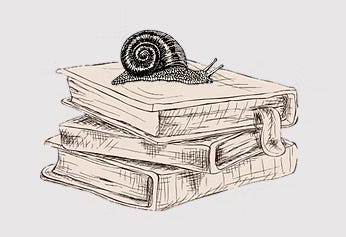
“I wish that poets were able to give straight answers to straight questions, but that is like asking astrophysicists to make their calculations on their fingers, where we can watch the process. What I would like to know is: how should I feel about the earth, these days? Where has all the old nature gone?”
—Lewis Thomas, from "The Medusa and the Snail: More Notes of a Biology Watcher"
Hi Friends,
Today’s post is an interview with Sophia Indelicato & Bethany Cutkomp, who share their insights into Thomasonian, a publication showcasing knowledge about the natural world from the minds who pay it the most attention.
WRJ collaborators Rachel Turney, Ellis Eden, and Allison Camp did the honors of conducting the interview, and they created some thought-provoking questions for the editors, weaving together threads of their personal journeys, nature topics, and info about their roles at Thomasonian.
Here is a bit more about the publication.
Thomasonian is a literary magazine showcasing knowledge about the natural world from the minds who pay it the most attention.
Inspired by the writing of essayist and physician Lewis Thomas, our publication combines the literary with the scientific.
We want poems written by biologists and nature essays written by poets (think Annie Dillard). Educate us about a personal run-in with the creatures in your backyard, or paint us a literary picture inspired by findings from a lab. We want to know what you specialize in, professionally or passionately.
We’re interested in pieces that leave readers a bit more familiar with how our world works. And of course, we’re open to any grounded suggestions on how to save the planet, too.
We publish creative nonfiction, informal essays, poetry, and photography. See submission guidelines here.
Question from Allison Camp: Did you have any formative childhood experiences that drew you into an interest in nature and science?
Sophia: When I was a kid, I was really interested in anything little and gross-looking, such as frogs, caterpillars, worms, and slugs. I spent a lot of time with my head to the ground looking for these guys, picking them up, sometimes taking them home with me for a bit of observational study. My childhood home was surrounded by a state park, so there was boundless terrain to explore and little creatures to find. It’s pretty much something I’ve never grown out of.
It’s made me interested in nature for a few reasons, one being it’s so nice and peaceful. It fills you with a loving sense, and a sense of belonging. Author Lewis Thomas, our inspiration for the magazine, has an essay about mitochondria, in which he explains that cells, animals, plants, and humans all have that same organelle, and maybe that’s what gives you your universal and connective feeling when you’re out in nature.
When I was little, I also liked nature because it was a place to satiate boundless curiosity. It’s fascinating to me that you can go outside to, say, the woods or a pond, and know next to nothing about what you’re looking at, at least on a deeper, ecological and microbiological level. And even if you do, things still pop up that surprise you.
As a child, I don’t think there’s ever been a time I went out in nature and didn’t leave with questions, and that’s what has piqued my interest in science. I’m always wanting to absorb as many answers as I can in terms of science and biology, and it seems to me that there will never be a time that questions won’t still be rolling in.
Question from Ellis Eden: What animal or plant are you currently obsessed with and why?
Bethany: I’m a huge fan of the organisms labeled as “peculiar” and “unloved.” Last year, Patrik Svensson’s The Book of Eels had me hooked on the mystery of the European eel (Anguilla anguilla) and scientists’ exhaustive efforts to chart their reproduction. Currently, the bigfin squid (Magnapinna) has my heart tangled in its record-length tentacles. This elusive cephalopod embodies the obscure and otherworldly nature of the deep sea. Only about a dozen Magnapinna sightings have been documented worldwide, and their existence is still relatively unknown to scientists other than brief observations from remote-operated deep-sea vehicles. Oh, to be a scary-looking squid dude drifting through the deep, dodging any perceiving eye. Look up a photo of one! Those alien, spindly appendages dangling beneath them (twenty times the length of their bodies—they’re basically all legs!) evoke a sense of dread and awe.
It reminds me just how much us humans have yet to learn about our own planet. We’re out here trying to map the universe but we haven’t even charted a majority of our oceans. Isn’t that astonishing?
I love any opportunity to feel the wonder that I did as a child, and the bigfin squid is just one organism of many that rekindles that unbridled fascination in me. Those guys are really just out there chilling in the hadal zone, untouched by human influence. Love that for them. Thanks for allowing me the space to nerd out a bit! I feel like I learn all of these facts and have nobody to share them with, except for Sophia over text, and sometimes my coworkers if they’re willing to endure random info-dumps from me.
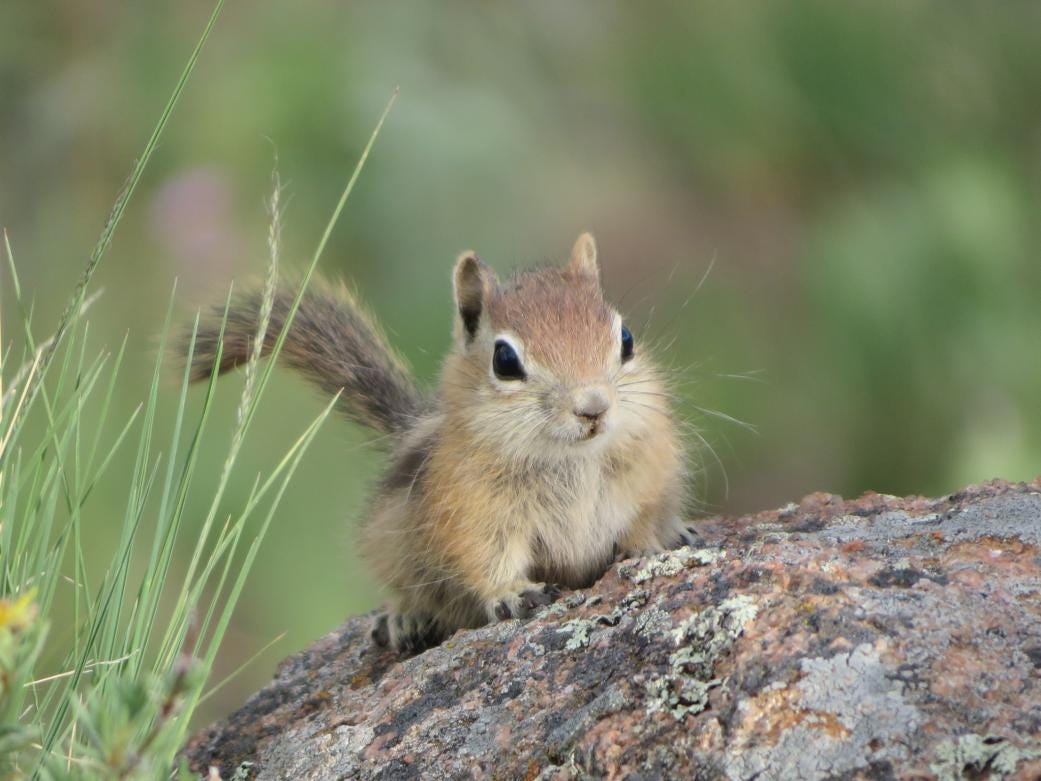
Commonly confused as chipmunks, this Colorado resident is the golden-mantled ground squirrel (Callospermophilus lateralis) native to the Rocky Mountains region of Canada and western United States. Unlike chipmunks, golden-mantled ground squirrels have no distinct stripe markings on their face and live in social colonies rather than in solitude.
Photos courtesy of Bethany Cutkomp
Question from Ellis Eden: What’s the strangest or most profound experience you’ve ever had in nature?
Sophia: There was a period of time when I was getting into nature photography, so I rented a camera and a humongous lens and went off into the Missouri woods, sometime in the fall or early winter, so the entire forest floor was filled with dead leaves. I knew next to nothing about nature photography, other than that you just find a good spot to sit and wait a long time, maybe hours, in front of something interesting.
After a whole day of next to nothing in terms of good photos, I plopped in the middle of the woods, sat on a log, and waited so long I started to drift off. I awoke with a start when I heard something clumping in the leaves and hurtling towards me. My body was telling me I should run, but I froze, taking turns between checking the camera and making sure I wasn’t about to be run over. Eventually two adult does came prancing into view. They were moving so fast because they were simply having fun, not running from something but chasing each other, gleefully hopping and prancing around. I fumbled with the camera. My heart started beating hard because one started charging towards me again, and I was worried she wouldn’t see me since I was so still. She did clock me, and stared directly at me, poised between two twisting branches like a frame.
I pushed every imaginable button on the camera, but I had only gotten it the day before. I couldn’t figure out the focus. The doe huffed, stamped her foot, turned and jumped so high, so slowly, she was literally suspended in the air for a number of seconds, and danced off in the woods with her friend. It was like she was posing, giving me ample opportunity, but ultimately disappointed that I couldn’t figure out how to take the shot. I was disappointed too; I spent $200 just to rent the stupid stuff, and all I got was a blurry, cryptic photo. But I did leave happy to know, like a secret, that does spend their time just having fun in the woods.
Question from Rachel Turney: You live and work in the greater St. Louis area. What aspects of that urban and suburban part of the Midwest have been a joy, and conversely, a challenge for you as an artist?
Bethany: St. Louis is full of rich culture, underrated artists, and strong communities. Even though the city is seemingly huge, everyone seems to know of one another in the creative scenes, which make collaborations and support systems highly valued. Sophia and I grew up in suburban neighborhoods on opposite sides of the county (North County and South County) and it wasn’t until meeting in college that we realized we’d competed against each other in high school marching band.
Initially, I had a difficult time developing a strong sense of connection with St. Louis and its charms, because my neighborhood of one-story houses existed in a threshold between “not close enough to downtown to warrant identifying as a city resident” and “not far enough away from the city to reject all STL labels.” It wasn’t until returning to my suburban hometown following our four-year college residency in rural northern Missouri that I truly embraced St. Louis—and the Midwest at large—as home.
I now enjoy the versatility of suburban residency. While making trips out to wild, rugged terrains is on the top of my list of preferences, I still indulge in options of coffee houses to visit, reading events to attend, and parks to hike. Even within the STL area, there is much to find endearing regarding bits of nature: a particular great horned owl that residents know on a first-name basis. (Sophia and I once stumbled upon a group of birders in Forest Park, who introduced us to Charles, the esteemed owl himself, for example.)
Poems in Issue One of Thomasonian such as Duncan Cuervo’s “Urban Trees” and Kro’s “an inadequate attempt to describe the zen of birding on the Southeast Side of Chicago” have reminded me that nature does in fact exist outside of what wild, remote ecosystems first come to mind. Once I made that realization, I started discovering bits of the outdoors and sources of creativity in my everyday encounters, even if that sometimes just involved catching and admiring carpenter bees in my public library’s community garden.
I’m a huge fan of the organisms labeled as “peculiar” and “unloved.” Currently, the bigfin squid (Magnapinna) has my heart tangled in its record-length tentacles. This elusive cephalopod embodies the obscure and otherworldly nature of the deep sea. Only about a dozen Magnapinna sightings have been documented worldwide, and their existence is still relatively unknown to scientists other than brief observations from remote-operated deep-sea vehicles. Those alien, spindly appendages dangling beneath them (twenty times the length of their bodies—they’re basically all legs!) evoke a sense of dread and awe.
— Bethany Cutkomp
Question from Allison Camp: In an essay titled “This Nature,” Pattiann Rogers posits that “nature” is truly everything, including manmade things. She writes: “Ash pits, boggy graves, nuclear bombs, tubercle bacillus, Yosemite Falls, abortion, the polio vaccine, are all part of the sum total of everything that is, and therefore nature.”
What are your thoughts about this broad definition of nature and its potential to upend what we typically think of eco-poetry? Where do you see the limits of “nature” as you consider pieces for Thomasonian?
Sophia: This is a really interesting question! I suppose in a way all those things could be nature, if you think of culture and invention as an offshoot of humans’ presence as “animals.” And chemically, everything always boils down to natural objects in one way or another: the nuclides in nuclear reactions, the metal of the syringe dispensing the vaccine, the inactivated poliovirus inside. For Thomasonian, I would consider any piece that discusses something natural of the earth through the lens of science and study. It’s easy to speak about plants and animals, since their makeup is automatically natural and earthly, but even if the subject was, say, a bird, I’d prefer if the piece discusses the bird’s behavior, ecology, history, habits, etc., that gives us a deeper understanding of the bird and our world opposed to the author seeing a bird and deciding that it was nice. I’d be open to a piece on nuclear bombs if it had an emphasis on their effect on the natural world or perhaps of their natural, chemical composition. The devastating title essay of Lewis Thomas’s collection Late Night Thoughts on Listening to Mahler’s Ninth Symphony is actually about nuclear bombs and their effect on Hiroshima and Nagasaki, and given that he’s our namesake, I’d say it’s a perfect companion for Rogers’ definition as well as an example of our standpoint. (Or at least mine. I’d be curious to what Bethany’s answer would be!) I think, actually, it’s good to hear about these critical man-made topics from the perspective of those caring and knowledgeable of the natural sciences. Now I’m hoping someone will send us a piece on data centers…
Question from Ellis Eden: I know Bethany takes some amazing travel photos. Are you willing to share a few?
Bethany: That’s such a lovely compliment, thank you! Absolutely, I’d be happy to share some of my travel photos. I’ll even format them with educational captions just like how we’d like to see in our photography submissions.
1 (Top left): This gorgeous turquoise hue to Yoho National Park’s Emerald Lake is caused by rock flour (fine particles of powdered rock) and glacial silt reflected in the sunlight. The water’s color and intensity shift from season to season depending on how much silt and light are present at a time.
2 (Top Middle): Unlike the bison reintroduced to Theodore National Park in 1956, their natural predators—wolves and bears—remain absent after being driven locally extinct in the 1800s. To properly manage an unbalanced ecosystem, the park staff steps in every few years to conduct a bison roundup. The roundup measures and determines which bison are best suited to be released back into the park and which will be culled and rehomed to Native American tribes, zoos, and state parks.
3 (Top right): An adult and juvenile American white ibis (Eudocimus albus) wade through Florida wetlands to feed on aquatic invertebrates. Baby white ibises hatch with straight bills and splotchy brown plumage. As they grow, they will acquire more white feathers and their bills will curve like their parents.
4 (Bottom left): This is one of Denali National Park’s blonde Toklat grizzlies (Ursus arctos horribilis). Grizzly bears residing in Alaska’s interior live off of berries, seeds, and vegetation, producing them generally smaller in size than those feeding on protein-rich salmon on the coast.
5 (Bottom right): What makes Joshua Tree National Park’s mountain ranges unique is that they run east to west rather than north to south. Known as the Traverse Ranges, these mountains in southern California are some of the only ranges with this latitudinal orientation in the United States.
As a child, I don’t think there’s ever been a time I went out in nature and didn’t leave with questions, and that’s what has piqued my interest in science. I’m always wanting to absorb as many answers as I can in terms of science and biology, and it seems to me that there will never be a time that questions won’t still be rolling in.
— Sophia Indelicato
Give it up for Sophia and Bethany! We’re grateful that they took the time to participate in our series of lit mag interviews.
Sophia Indelicato is a writer, filmmaker, musician, and biology enthusiast from St. Louis, MO. Her work has appeared in A Moment Zine, The Yesterday Review, and redrosethorns.
Sophia is (clearly) one of Lewis Thomas’s biggest fans, though she loves the works of Annie Dillard and Rachel Carson as well. She continues to envision a world where writers can be involved in the conversation about the natural world, and scientists continue finding ways to share with the common man.
Her favorite hobbies include forcing her friends and family to go herping with her, plotting how to save the world with the power of creativity, and looking at bugs. One of her favorite things about nature is the way toads hop.
Bethany Cutkomp is an award-nominated writer of surreal and existential fiction from St. Louis, MO. Although she’s drawn to adventure beyond her home state, the familiar pull of the Midwest and its quirks calls her home. Her work appears in X-R-A-Y, trampset, Stanchion, HAD, Ghost Parachute, and more.
Bethany is especially fond of writing that connects the self with the natural world, such as works from Aimee Nezhukumatathil and Patrik Svensson. Through creative expression, she hopes to spread concern and curiosity toward studying and protecting the environment.
She enjoys stargazing, hiking three times longer than trailheads report, and snatching up small critters with her bare hands. Her favorite thing about nature is the overlap of characteristics regarding deep space and deep sea.
Subscribe to see more guest posts from WRJ’s amazing contributors / Paid access includes opportunities for editorial feedback and free submissions for upcoming issues.
Aaron did a marvelous job of threading all these elements together, and I loved reading Bethany and Sophia’s thoughts. I also laughed out loud at the deer story, because I think every photographer can relate to missing perfect shots because of tech malfunctions or problems. It’s the creative equivalent to the one that got away.











Aaron did a marvelous job of threading all these elements together, and I loved reading Bethany and Sophia’s thoughts. I also laughed out loud at the deer story, because I think every photographer can relate to missing perfect shots because of tech malfunctions or problems. It’s the creative equivalent to the one that got away.
Great interview questions and answers! I will surely be researching the bigfin squid.